WELCOME TO
KLEINHARDT
WELCOME TO
KLEINHARDT
WELCOME
We help businesses to be profitable, corporations to increase performance, projects to prove viability, proponents to find investment, industries to develop and regional economies to grow.
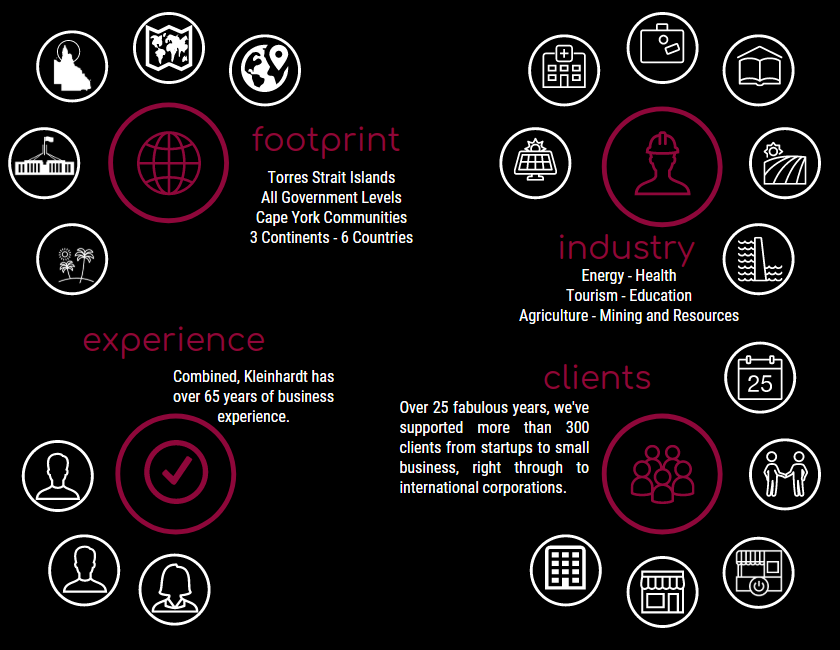
Kleinhardt is a business advisory and economic development firm based in Cairns with a depth of experience in corporate, enterprise, industrial and regional economic development. This experience has been accumulated by servicing hundreds of clients throughout Cairns and its regions, Queensland, Australia, Papua New Guinea and other international locations over the last 25 years.
CONTACT US
Got a Question?
Want to discuss your business or project?
Not quite sure what ‘the next step’ is?
Or
Know exactly what you want and need to know if we’re the right ones to help get you there?
Get in touch!

BUSINESS CONSULTING
Planning, Advice, Growth & Strategy

REGIONAL ECONOMIC DEVELOPMENT
Feasibility Studies, Business Case, Regional Strategy & Project Work.

BUSINESS SALES
Sales, Acquisitions, Valuations & Due Diligence
WELCOME
We help businesses to be profitable, corporations to increase performance, projects to prove viability, proponents to find investment, industries to develop and regional economies to grow.
Kleinhardt is a business advisory and economic development firm based in Cairns with a depth of experience in corporate, enterprise, industrial and regional economic development. This experience has been accumulated by servicing hundreds of clients throughout Cairns and its regions, Queensland, Australia, Papua New Guinea and other international locations over the last 25 years.
CONTACT US
Got a Question?
Want to discuss your business or project?
Not quite sure what ‘the next step’ is? Or
Know exactly what you want and need to know if we’re the right ones to help get you there?
Get in touch!
BUSINESS CONSULTING
Planning, Advice, Growth & Strategy
REGIONAL ECONOMIC DEVELOPMENT
Feasibility Studies, Business Case, Regional Strategy & Project Work.
BUSINESS SALES
Sales, Acquisitions, Valuations & Due Diligence
MEET THE TEAM
Dynamic, experienced, connected and progressive. Our in-house team of Cam and Jim have over 65 years of experience in business, industry and economic development. We stay light on the ground by choice, enabling us to assemble skills-based teams for larger projects.

MEET THE TEAM
Dynamic, experienced, connected and progressive. Our in-house team of Cam and Jim have over 65 years of experience in business, industry and economic development. We stay light on the ground by choice, enabling us to assemble skills-based teams for larger projects.
BUSINESS CONSULTING
We help small business owners right through to larger companies to plan, develop, grow and strategically strengthen their business. We model, we analyse, we research, we test the feasibility. We give you the best possible advice to achieve your business and personal goals.
BUSINESS SALES
We specialise in the sale of good quality businesses in North Queensland and Papua New Guinea. We have established business networks & knowledge of local markets to deliver success.
REGIONAL ECONOMIC DEVELOPMENT
Kleinhardt has a long history in Regional Economic Development projects throughout Queensland and Papua New Guinea across a wide range of Industry sectors.
BUSINESS CONSULTING
We help small business owners right through to larger companies to plan, develop, grow and strategically strengthen their business. We model, we analyse, we research, we test the feasibility. We give you the best possible advice to achieve your business and personal goals.
BUSINESS SALES
We specialise in the sale of good quality businesses in North Queensland and Papua New Guinea. We have established business networks & knowledge of local markets to deliver success.
REGIONAL ECONOMIC DEVELOPMENT
Kleinhardt has a long history in Regional Economic Development projects throughout Queensland and Papua New Guinea across a wide range of Industry sectors.
NUMBERS
DON’T
LIE
WHY CHOOSE US?
1. OVER 65 YEARS COMBINED EXPERIENCE
65 + years of advising business and industry between three; that’s pretty impressive! It means you’re working with people who have seen what works, and what doesn’t work over the long term. Our experience is your advantage.
2. WE'RE A LITTLE TEAM OF BIG THINKERS
We keep our Kleinhardt finger well and truly on the Cairns and Far North Queensland pulse – but we also take time to continually reinvent our thinking inline with global events and business trends.
3. NETWORKS AND CONNECTIONS
We are constantly bringing together project-specific teams so we remain competitive for large scale works. This means you truly get ‘local content’, but you also get global and specialised experience.
4. WE DON'T WORK FOR YOU
We work WITH you. We don’t want to see our work on a shelf; so we work hard with you, to make sure your skilled and confident to implement the planning/strategy/actions we chart together for your business, region or economy.
5. WE WANT TO SEE IMPLEMENTATION
Refer point 4. We actively seek projects where our skills can be utilised beyond the planning stage to ensure we see real outcomes.
6. PLANET AND PEOPLE
We believe that taking care of our businesses and our economies is a vehicle for taking care of our planet and our people.

GET IN TOUCH
Phone (within Aust)
0418 773 737
Phone (outside Aust)
+61 418 773 737
Postal Address
PO Box 433 Edge Hill Qld 4870
Street Address
173 Hillview Crescent, Cairns Qld 4870